
You already have a drafter
Jira will draft release notes from Jira, GitHub will draft them from pull requests, and Atlassian will sell you an agent that does it inside the wall you already pay for. If the pitch is "AI writes the notes," it is competing with a button you already have for free.
Jira will draft release notes from tickets, GitHub will draft them from pull requests, and Atlassian will sell you an agent that does it inside the wall you already pay for. If the pitch is "AI writes the notes," it is competing with a button you already have for free.
That is not a reason to do nothing about the problem. It is a reason to stop treating drafting as the product.
The challenge for organizations
A mid-size SaaS team ships every two weeks, and four to eight hours of a developer's or writer's time goes into assembling the release notes each time. Leadership buys a vendor feature to solve it, and the notes do get smoother. Customers still file tickets about a change that shipped without a sentence, or about a sentence describing a fix that actually landed in the next milestone.
The outcome they wanted was never prettier prose. It was for the three systems that already describe the release to agree with one another.
What you already employ
Almost every team in this position already has all four of the following:
- A tracker that records a fix version or a milestone.
- A host where the code actually merges.
- A documentation site, a Confluence space, or a GitHub release body.
- Someone responsible for the notes, even if that someone is only "whoever tagged the release."
The gap those tools leave
Each vendor is strong on its own data and structurally weak across a competitor's. Jira has no way to know that the pull request which closed a ticket was never mentioned on the documentation site. GitHub has no way to know that a Confluence page still describes the bug as though it were unfixed. And the writer does not have a free afternoon to assemble that matrix by hand every two weeks.
I built that matrix against public releases to see what it would turn up. On Bootstrap v3.3.7, the documentation site and the release notes corroborated different work. On Caddy, a 90-day window produced 59 findings that a disciplined team would rightly ignore, while the same engine scoped to the v2.11.4 release found that every closed issue had a matching merge and returned four rows a release manager can work through in a single meeting.
How to bridge it today
The steps below are ones you can run yourself. Where a paid engagement differs is noted at the end.
Reconcile first, then draft, rather than the other way around.
- Scope the run to one repository, one tracker, one documentation source, and one release.
- Run the structural pass, which uses no AI model and writes nothing back.
- If the rows show that shipped work never reached the notes, then draft — and draft only from the rows that shipped.
- Have a person read the draft. Nothing publishes on its own.
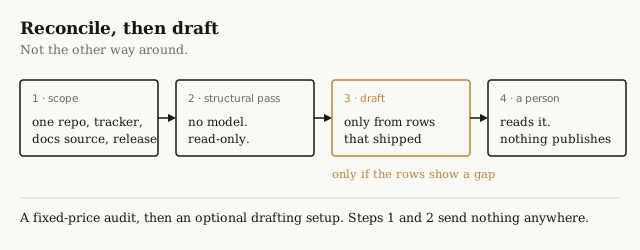
In commercial terms, that is a fixed-price audit followed by an optional drafting setup. The sequence survives the obvious question, "doesn't Jira already do this?", because the honest answer is that yes, it does — for Jira. The gap is between the systems, not inside any one of them.
What I will not bridge for you
There are four things I want to rule out plainly, because each of them gets promised elsewhere. I will not replace your writer. I will not turn the audit into a bot that opens tickets on its own. I will not scope SharePoint or ServiceNow into an engagement until readers for them actually exist. And I will not call a skipped documentation check a clean release.
If your linkage is already in good order and a drafter is genuinely all you want, then you may not need any of this. A fifteen-minute look at whether your release notes and your documentation site cite the same identifiers is enough to tell you which situation you are in.